
Every year, schools and districts dedicate time, money, and considerable effort to recruiting Black teachers. They attend and host hiring fairs, build partnerships with educator preparation programs, reconsider their recruitment messaging, and develop initiatives intended to attract a more diverse teaching workforce.
These efforts represent important steps forward, yet even the most ambitious recruitment strategies can only accomplish so much. Bringing Black educators into classrooms does not guarantee that the schools welcoming them are places where they can build fulfilling, sustainable careers. A school can become better at hiring Black teachers without becoming a better place for Black teachers to work.
As we explored in Keeping Black Teachers Is Not the Same as Sustaining Them last month, retention tells us who stays, while sustainability asks us to consider what staying requires. That distinction becomes even more consequential when we consider the institutional cultures Black teachers enter, the expectations they navigate, and the everyday decisions that shape their professional experiences. A growing body of research reveals how these conditions shape Black teachers’ experiences, including the often-unrecognized responsibilities they carry, the professional relationships available to them, and the institutional barriers that can make remaining in the profession increasingly difficult.
The Distance Between Getting Hired and Wanting to Stay
Recruiting Black teachers is an important and necessary commitment. Research has consistently demonstrated the contributions Black educators make to students’ academic experiences, relationships, and opportunities. In a 2024 study published in Educational Researcher, researcher David Blazar examined how teachers of color influence student outcomes, finding meaningful benefits for students’ academic achievement, engagement, and attendance. The study also identified instructional practices and mindsets, including strong relationships with students and families, high expectations, and responsive instruction, that helped explain these outcomes. The significance of this research extends beyond the case for representation. Black teachers bring pedagogical and cultural knowledge, professional expertise, and commitments that deserve to be recognized and supported in their own right, rather than valued exclusively through what they contribute to student outcomes.
And still, the growing emphasis on recruiting Black teachers has not always been matched by attention to the professional environments they enter. Research suggests that these conditions can significantly influence whether Black educators remain in their schools and in the profession. A 2024 working paper published by the Annenberg Institute at Brown University examined racial isolation, workplace experiences, and teacher turnover using longitudinal data from Tennessee. Researchers found that Black teachers working in schools with fewer same-race colleagues were more likely to leave their schools than their less-isolated counterparts, even after accounting for other factors. These teachers also reported less collaboration with colleagues and received lower classroom observation scores.
The findings complicate the assumption that getting Black teachers through the door is the primary challenge. Who a school hires matters, but so does the professional environment that awaits them. Racial isolation, opportunities for collaboration, and access to supportive professional relationships are not peripheral concerns. They are part of the working conditions that can influence whether Black teachers remain in their schools and in the profession. For school and district leaders, this raises an important consideration: recruitment success cannot be evaluated independently of the institutional conditions that shape teachers’ experiences after they are hired.
The School Culture Recruitment Alone Cannot Change
School culture is often described through its most visible expressions: shared values, staff relationships, traditions, and the language used to communicate a school’s mission. But culture is also shaped by the less visible decisions that determine whose expertise is recognized, how responsibilities are distributed, which educators receive meaningful support, and what happens when teachers’ professional commitments conflict with institutional norms.
A 2026 study titled “Our Kids Can’t Wait. It Can’t Just Be Me”: Black Women Science Teachers Navigate Mismatched Pedagogical Commitments offers a revealing look at these dynamics. Researchers Alexis D. Riley and Elisha Arnold explored how Black women science teachers navigated differences between their own pedagogical commitments and those of their colleagues and school environments. The teachers described maintaining high academic expectations for their students while navigating colleagues whose instructional approaches and expectations did not align with their own. Some found themselves dedicating additional personal time to developing culturally responsive curriculum, assuming responsibilities beyond their instructional roles, and compensating for institutional shortcomings without adequate recognition or support. The researchers connected these experiences to stress, burnout, and the harmful expectations that position Black women educators as perpetual problem-solvers for their schools.
What happens when the very expertise that makes a Black teacher valuable becomes the reason they’re expected to carry more than their colleagues? A teacher’s ability to connect with students should not automatically make them responsible for every racialized disciplinary challenge. Their commitment to culturally responsive instruction should not require them to compensate for the lack of preparation or accountability among their peers. Their willingness to advocate for students should not become an excuse for withholding the institutional support necessary to sustain that work. These are questions of organizational culture, professional expectations, and leadership responsibility. A recruitment strategy alone cannot resolve them because they concern how a school operates long after the hiring process ends.
What Retention Numbers Cannot Tell Us
the most frequently discussed indicators in efforts to strengthen the Black teacher workforce. Schools and districts track departures, examine turnover trends, and introduce strategies intended to encourage educators to remain. These measures can tell leaders something important about workforce stability, but they cannot fully capture the quality of the professional experiences teachers have while remaining.
At the Black Teacher Project, we make an important distinction between retaining Black teachers and sustaining Black teachers. Retention is an outcome. Sustainability is an ongoing practice.
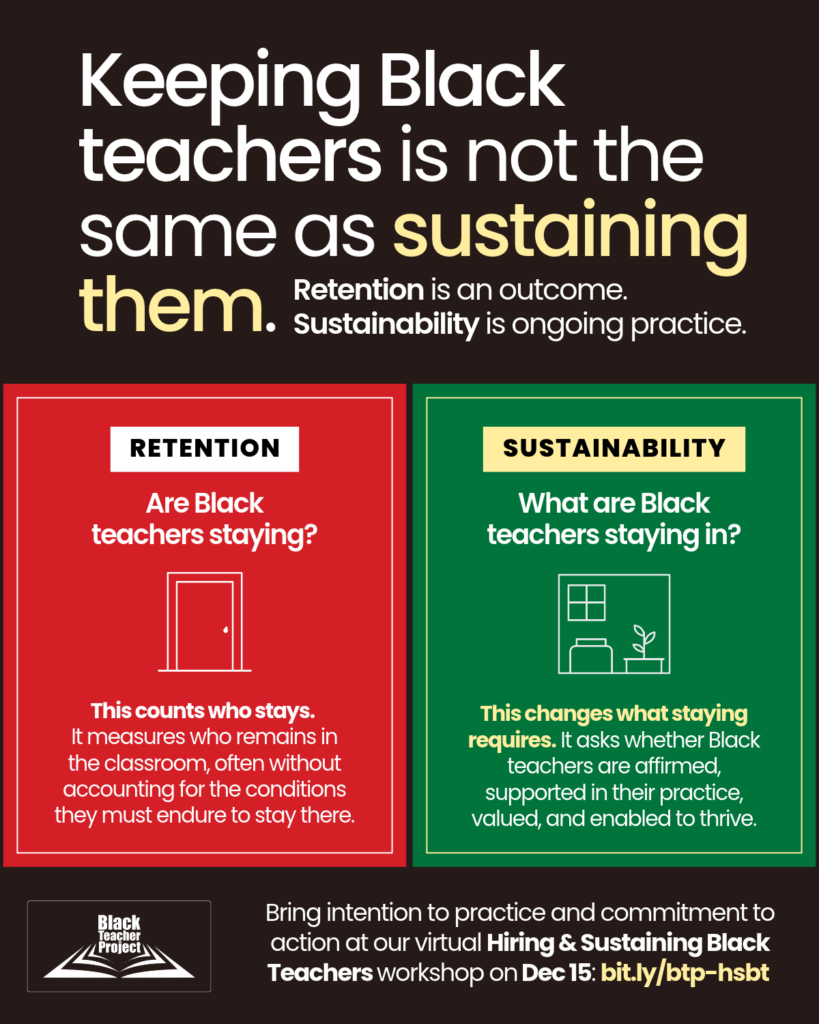

A Black teacher may remain in a school because of their relationships with students, their commitment to a community, or the financial realities of changing jobs. Their continued employment does not necessarily indicate that they feel affirmed, supported in their instructional practice, valued for their expertise, or empowered to grow professionally. This distinction becomes especially important when considering what research tells us about the experiences of Black educators who continue teaching despite institutional barriers. The Black women science teachers in Riley and Arnold’s study demonstrated considerable commitment to their students while navigating environments that did not adequately support their work. Their persistence did not erase the additional burdens they carried.
For school and district leaders, the presence of Black teachers should never be mistaken for evidence that the conditions necessary for their thriving are already in place. Sustainability requires attention to what makes a professional environment worth remaining in. It calls for institutional practices that affirm Black teachers’ identities, strengthen their instructional practice, support their well-being, recognize their contributions, and create meaningful opportunities for leadership. This shifts the focus from simply counting who stays to examining what staying requires.
School Culture Is Shaped by Decisions, Just Not Intentions
The institutional conditions that shape Black teachers’ experiences are not fixed. They are created, reinforced, and sometimes challenged through the decisions school and district leaders make, from how responsibilities are distributed and professional learning is structured to whose expertise is valued and whose voices influence institutional decisions.
These everyday practices invite a closer examination of the distance between a school’s stated commitments and the experiences of the Black teachers working within it. They also raise important questions about where leadership has the power to interrupt longstanding patterns and create something different.
The research offers no single intervention capable of resolving every challenge Black teachers encounter. It does, however, underscore the importance of taking their workplace experiences seriously and recognizing that the responsibility for creating supportive conditions cannot rest on Black teachers alone. A hiring strategy can open the door. Sustaining Black teachers requires changing what happens on the other side of it.
Bring Intention to Practice
School and district leaders have an important role in shaping what Black teachers experience long after they’re hired. Recognizing where institutional practices fall short is part of that responsibility. Knowing how to change them, particularly within the complexities of school and district systems, requires deeper reflection, practical strategies, and opportunities to learn alongside others navigating similar challenges.
On Tuesday, December 15, 2026, from 9:30 am to 12:30 pm PT, the Black Teacher Project invites school and district leaders, administrators, and hiring professionals to participate in our virtual Hiring & Sustaining Black Teachers workshop. Grounded in research and Black teachers’ lived experiences, this interactive learning opportunity creates space to examine the policies, practices, and working conditions shaping Black educators’ professional lives. Participants will bring real challenges into conversation, learn alongside peers, and identify actionable strategies for strengthening recruitment and creating conditions where Black teachers can stay, grow, lead, and thrive.
School culture is shaped by decisions, practices, and expectations that leaders have the power to examine and change. The conditions Black teachers deserve depend, in part, on what leaders choose to do differently. Register for Hiring & Sustaining Black Teachers.