
A Black teacher’s decision to stay is shaped long after the offer letter is signed. It is shaped in meetings where their voice is heard or dismissed, in the expectations placed upon them, in the opportunities extended to them, and in the support available when the work becomes difficult. It is shaped by whether their expertise is trusted, their identities affirmed, their leadership cultivated, and their humanity honored beyond what they can give to students.
For ten years, the Black Teacher Project has listened to, learned alongside, and worked with Black educators to understand what it takes not only to enter and remain in the profession, but to be well, grow, lead, and transform learning environments. Across a decade of relationships, research-informed practice, and direct engagement with schools and districts, one truth continues to emerge. Sustaining Black teachers requires more than a commitment to hiring them. It requires creating the conditions that allow Black teachers, and ultimately all educators, to teach and thrive.
The Difference Between Being Hired and Being Sustained
The urgency is written into the research. According to a 2025 UC Berkeley Research interview with BTP Board Member and education scholar Travis J. Bristol, Ph.D., Black teachers represented 8.6% of the national teaching workforce in 1990, compared with just 6.1% in 2020. Their declining representation stands in painful contrast to the growing body of evidence demonstrating how much Black teachers contribute to students and school communities. Bristol’s research highlights how Black teachers positively influence academic achievement, school attendance, access to advanced coursework, and student experiences across racial backgrounds, naming that every child benefits from learning experiences with Black teachers.

But recognizing the value of Black teachers is not the same as creating the conditions for them to stay. The Learning Policy Institute’s 2025 report, Supporting and Sustaining a Diverse Teacher Workforce, found that 9% of Black teachers left the profession in 2022, compared with 7% of white teachers. Its findings also illuminate the structural pressures shaping teacher turnover, including inadequate preparation, challenging working conditions, financial burdens, and insufficient access to mentoring. These are not simply questions of individual perseverance or professional commitment. They are questions about how schools are organized, how resources are distributed, and how leadership is exercised.
A retention rate can tell us how many teachers stayed but it cannot tell us what staying cost them and for school and district leaders, that distinction matters. Recruiting Black teachers into environments that remain unchanged risks reproducing the very conditions that make leaving necessary or desirable. The responsibility cannot end when a position is filled. It must extend into the daily experiences that make a career sustainable.
What a Decade of Listening Has Taught Us
At the Black Teacher Project, we believe that Black teacher thriving is both deeply personal and profoundly structural. Our work begins with Black educators as whole people, whose identities, wellness, knowledge, and leadership deserve nourishment in their own right.
That belief informs four interconnected pillars of our approach: Black Identity Development, Wellness, Quality Instruction Rooted in Blackness, and Black Leadership for Liberation. Through these commitments, we create spaces where educators can deepen their practice, experience care, strengthen relationships, and exercise greater agency in shaping the schools and systems around them.
Our 2025–2026 Impact Report offers a window into what this looks like in practice. Across 17 states, BTP served more than 350 Black teachers through programs, gatherings, coaching, and other learning experiences. From the Black Teacher Design Lab, where educators, working in thought partner teams, co-designed healing-centered solutions with their students, to wellness gatherings, fellowships, and professional learning communities, each experience was grounded in the understanding that Black teachers need opportunities to be nourished as well as opportunities to give.
And their reflections speak volumes. Among 80 Black teachers who responded to one program evaluation, 96% reported feeling revitalized to stay in the profession longer. In another group of 80 respondents, 100% reported an increased sense of the power they hold as Black teachers.
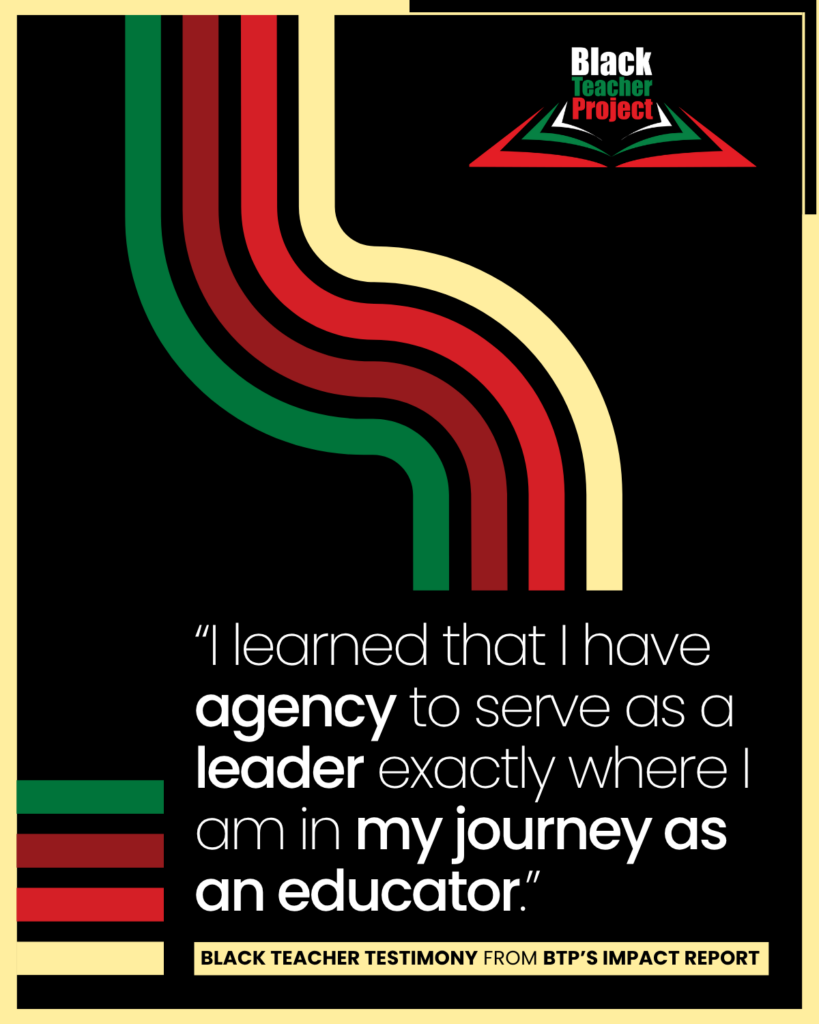
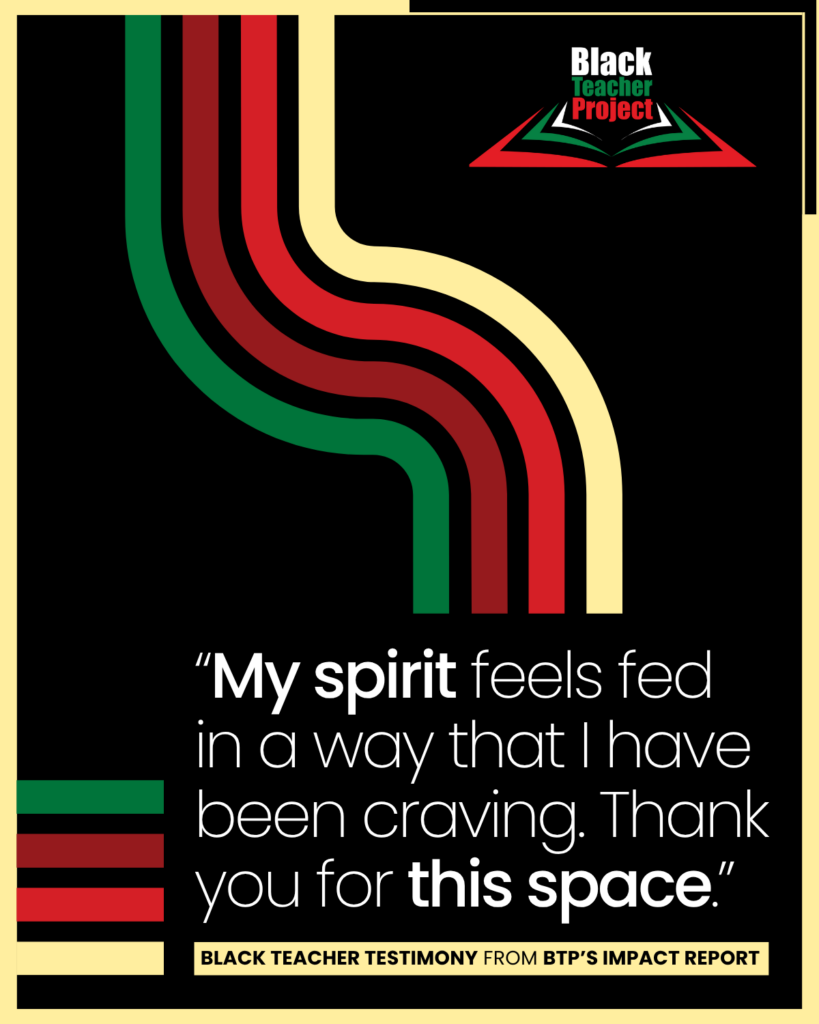
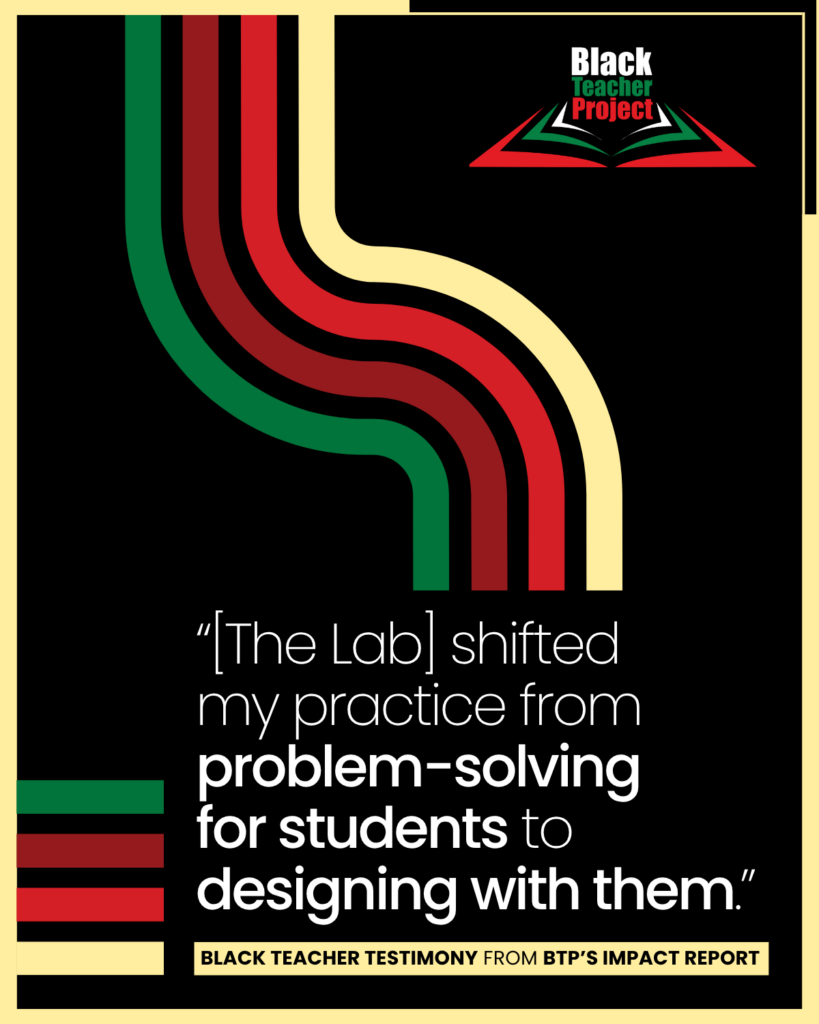
The testimonies and data points we get from Black teachers throughout the year offer more than an affirmation of a meaningful experience. They invite us to consider what educators may be going without in their everyday professional lives, and what becomes possible when those needs are taken seriously.
Our work also extends to the schools and districts responsible for shaping Black teachers’ everyday experiences. Throughout the school year, we engaged more than 51 school and system leaders and provided customized services to six districts and organizations, bringing our expertise into leadership development, racial affinity spaces, coaching, facilitation, and organizational learning.
At the heart of our theory of change is a belief that has guided us from the beginning. Black teachers should not have to become exceptionally resilient to survive conditions that schools have the power to improve. Their thriving requires both opportunities for personal and professional growth and institutional commitments that make such growth sustainable. Our partnerships with schools and districts are rooted in changing what Black teachers are asked to endure, rather than simply strengthening their capacity to endure it.
The Conditions for Staying are Conditions Leaders Can Change
In his UC Berkeley interview, Bristol also offers a pointed observation about Black teacher retention. “This conversation has to start with leadership.”
It is a challenge worth taking seriously. Principals, superintendents, hiring managers, and district leaders influence far more than staffing decisions. They shape professional expectations, access to mentorship, opportunities for advancement, the distribution of resources, and the cultures in which educators spend their working lives.
In the latest episode of the Black Teacher Project Podcast, Dr. Daryl Rock reflects on his leadership at Brooklyn’s Benjamin Banneker Academy, offering a compelling example of that responsibility in practice. The former principal and author of They Were Black. All Black: A High School Success Story, recalled how recruitment was never confined to a hiring season. He cultivated relationships with universities, sought out prospective educators, and made identifying promising teachers an ongoing part of school leadership. As he shared, “It has to be something that’s done all the time.”
Banneker’s story also reveals that the work extended beyond bringing teachers into the building. It meant building a culture where educators shared a belief in Black children’s possibilities, strengthened one another’s practice, and contributed to a school community grounded in care, rigor, and belonging. Hiring was an intentional practice as was creating an environment where teachers could do meaningful work.
The Learning Policy Institute‘s findings reinforce the importance of these conditions. In 2021, early-career teachers of color were less likely than their white peers to report receiving mentoring during their first year of teaching, 79% compared with 83%. Supportive working conditions, comprehensive preparation, competitive compensation, and mentoring were also named as important factors associated with teacher retention in the report.
The findings and experiences point toward practical questions for school and district leadership. What happens after a Black teacher accepts an offer? Who supports their development? What opportunities exist for them to influence decisions? And when Black educators identify barriers to their well-being and success, what changes as a result?
From Commitments to Conditions
These questions sit at the heart of BTP’s ongoing work with school and district leaders. This December, we’re inviting education leaders to explore them with us and consider what it takes to turn reflection into action.
On Tuesday, December 15, 2026, from 9:30am to 12:30pm PT, BTP will host Hiring & Sustaining Black Teachers, an interactive virtual workshop designed for school and district leaders ready to move from understanding why Black teachers matter to examining what they can do to recruit, hire, support, and sustain them. Across three hours, participants will explore the historical and present-day realities shaping Black teachers’ experiences, examine their own institutional practices, and engage in facilitated reflection, breakout conversations, and thought partnership around real leadership challenges. The goal is not to leave with another statement of commitment, but with greater clarity about the decisions, relationships, and practices within their power to change.
Every child deserves a Black teacher, and every Black teacher deserves a school where they can be well, grow, stay, and lead. Ten years into our work, that future remains both our commitment and our invitation. Our latest Impact Report tells part of the story of what sustained investment in Black educators can make possible. The next chapter depends, in part, on what school and district leaders are willing to do with what we know.
If you lead a school, district, or education team, register for Hiring & Sustaining Black Teachers and bring your questions, challenges, and willingness to act. And if you know a school leader who should be part of this conversation, forward them this invitation. A different experience of teaching is possible, and the work of making it real belongs to all of us.